Chalky Film On Glassware From A Viking Dishwasher
A white haze on glasses is the first thing hard water does to a dishwasher, and it shows up long before any fault code. How to tell scale from etching, what to check in the machine, and the point at which cleaning stops working.
Written by
Lucia Esperanza
Service technician — heat load and high ambient · 13 years in the trade
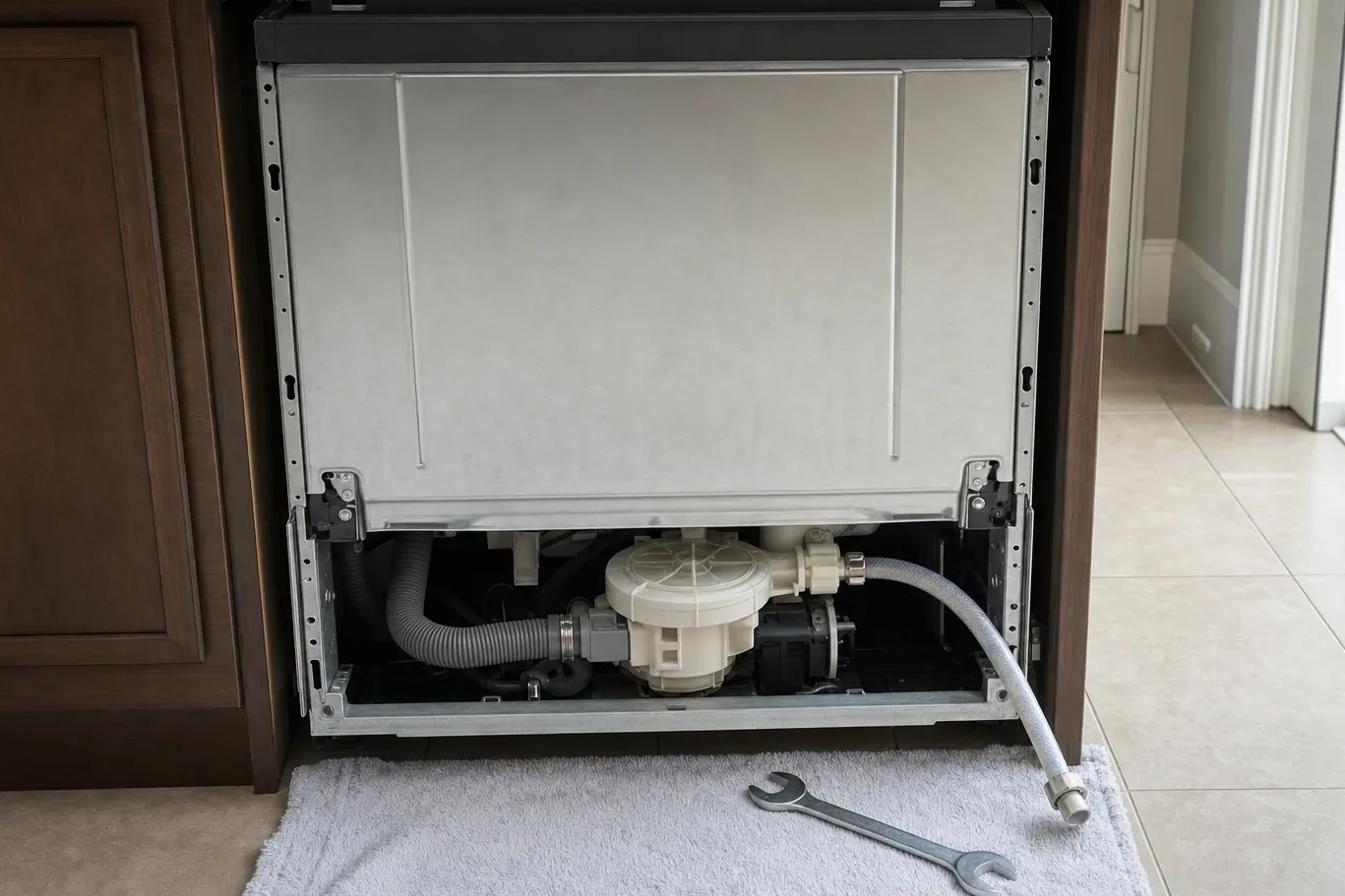
Phoenix tap water is hard, and a dishwasher is the appliance in the house that notices first. The initial sign is not a fault code, a leak or a noise. It is a thin white haze on clear glassware that appears gradually enough that most people blame the detergent, switch brands twice, and only phone once the plates are coming out gritty too.
It is worth separating two things at the start, because they look similar and have opposite causes. Mineral scale is a deposit sitting on top of the glass; it comes from dissolved calcium and magnesium drying in place, and it comes off. Etching is damage to the glass surface itself, caused by water that is too soft combined with too much detergent and a hot cycle; it does not come off, ever. Ten minutes in white vinegar tells you which one you have before anybody opens the machine.
What hard water actually does inside the machine
Every fill brings dissolved minerals in. Most leave with the drain water. What stays behind deposits wherever water sits, evaporates or is heated — and in a dishwasher that means three places in particular.
The heating element is the worst affected, because scale precipitates fastest at the hottest surface. A furred element transfers heat poorly, so the control runs it longer to reach the same set point. That is why a scaled machine’s cycle time creeps up over a couple of years with no fault anywhere.
The wash arms are the second place. Each arm relies on a specific pattern of small holes to produce coverage and pressure. Scale narrows those holes from the inside, and because it happens evenly there is no obvious blockage to find — just a machine that quietly stops reaching the back of the top rack.
The third is the fill valve seat and the inlet screen. Mineral build-up there produces slow fills, then short fills, then a valve that weeps because the seat no longer closes cleanly. A slow fill starves the wash arms of pressure, which looks exactly like a pump problem and is not one.
The checks worth doing before you call anybody
All of these are safe with the door open and the machine off at the breaker where noted.
- Do the vinegar test on a hazed glass. Scale or etching decides everything that follows.
- Take the lower wash arm off — usually a single hand-tight nut — and hold it up to a light. You should see clean round holes. Fuzzy, narrowed or partly closed holes are your pressure loss.
- Do the same with the upper arm and the ceiling spray if the model has one.
- Pull the filter assembly and rinse it. Then look underneath it at the sump and the pump inlet for grit and glass chips.
- Look at the heating element. A chalky white crust rather than clean metal tells you how long this has been running.
- Run a hot empty cycle with a citric-acid dishwasher descaler in the detergent cup and see how much of the haze that removes from the next real load.
- Check whether rinse aid is actually being drawn down. A dispenser that has not emptied in months is either not being released or not being filled.
What to leave alone: the heating element terminals, the door interlock, anything behind the lower access panel with the machine live, and the wash motor itself. Those are the parts where water and mains voltage share a space, and there is nothing there a homeowner can usefully adjust.
When cleaning has stopped being enough
There is a point at which descaling no longer restores the machine, and it is fairly easy to recognise. If a full descale cycle makes no difference to the film, if the glasses come out gritty as well as hazed, or if the cycle now takes noticeably longer than it used to, the scale has moved from being a coating to being a mechanical problem.
At that stage the usual work is replacing the wash arms rather than trying to clear them, because scale inside an arm cannot be reached and a narrowed arm never comes back to its original pattern; renewing the heating element if the crust is heavy enough to have been cooking on for years; and cleaning or replacing the fill valve if fill time has drifted. Levelling gets checked at the same time, because a machine sitting out of level pools water at one end of the tub and accelerates everything described above. It is remarkable how many builder installations were never levelled at all.
A wash arm with its bearing worn is worth mentioning separately. If the arm has been dragging on a sagging upper rack — a common pairing in houses where the rack rollers have broken — it will have worn its bearing oval, and it will never spin freely again no matter how clean the holes are.
What we do differently in a hard-water valley
Two things, and neither of them is a product.
The first is that we measure water hardness at the tap rather than assuming it, because the number varies noticeably across the valley and it changes what interval to recommend. A house on city supply in Deer Valley and a house on a well out past the fields do not need the same schedule, and telling both of them “every three months” is just guessing politely.
The second is that we say when the appliance is not the problem. If the machine is mechanically sound and the water is simply hard, the honest answer is a maintenance interval, rinse aid, and a conversation about whether treating the water is worth it for the whole house rather than replacing dishwasher parts every few years. That answer does not sell a part, which is exactly why it is worth hearing from somebody who could have sold you one.
Follow-up questions
-
Is the film scale, or has the glass been etched?
Put the glass in white vinegar for about ten minutes. If the haze wipes off, it is mineral scale sitting on the surface and it is fixable. If the glass still looks cloudy after soaking and the cloudiness has a slightly rainbow sheen in the light, the surface itself has been etched and no amount of cleaning brings it back. Etching comes from soft water plus too much detergent plus high heat, which is the opposite problem and needs a different fix.
-
Will rinse aid solve it on its own?
It helps and it is worth using, but it treats the symptom. Rinse aid lowers surface tension so water sheets off instead of drying in place as droplets, which reduces spotting. It does nothing about the scale already caked on the heater and inside the wash arms, and nothing about the mineral load coming in through the fill valve.
-
Should I be running a descaler through it, and how often?
In this valley, a citric-acid dishwasher descaler every two to three months on an empty hot cycle is reasonable, and monthly if you are on a well. Avoid household bleach and avoid anything abrasive: the tub, the seals and the wash arm bearings are the parts that pay for aggressive chemistry.
-
Can hard water actually break the machine, or only spoil the wash?
It breaks things eventually. Scale on the heating element makes it run hotter to reach the same temperature, which shortens its life. Scale in the wash-arm holes drops pressure and dumps the load quality. Scale on the fill valve seat causes slow fills and eventually a valve that will not close. All three start as a film on your glasses.
dishwasherhard waterscalediagnosticswash quality