Viking Stove Top Not Heating: Silent, Clicking or Weak Burners
A stove top with no heat almost always has a power, spark or blocked-burner fault: check the breaker, reseat the burner cap, clear clogged ports and dry the igniter. This guide shows Viking owners in Phoenix how to sort it out safely and when a technician is needed.
Written by
Lucia Esperanza
Service technician — heat load and high ambient · 13 years in the trade
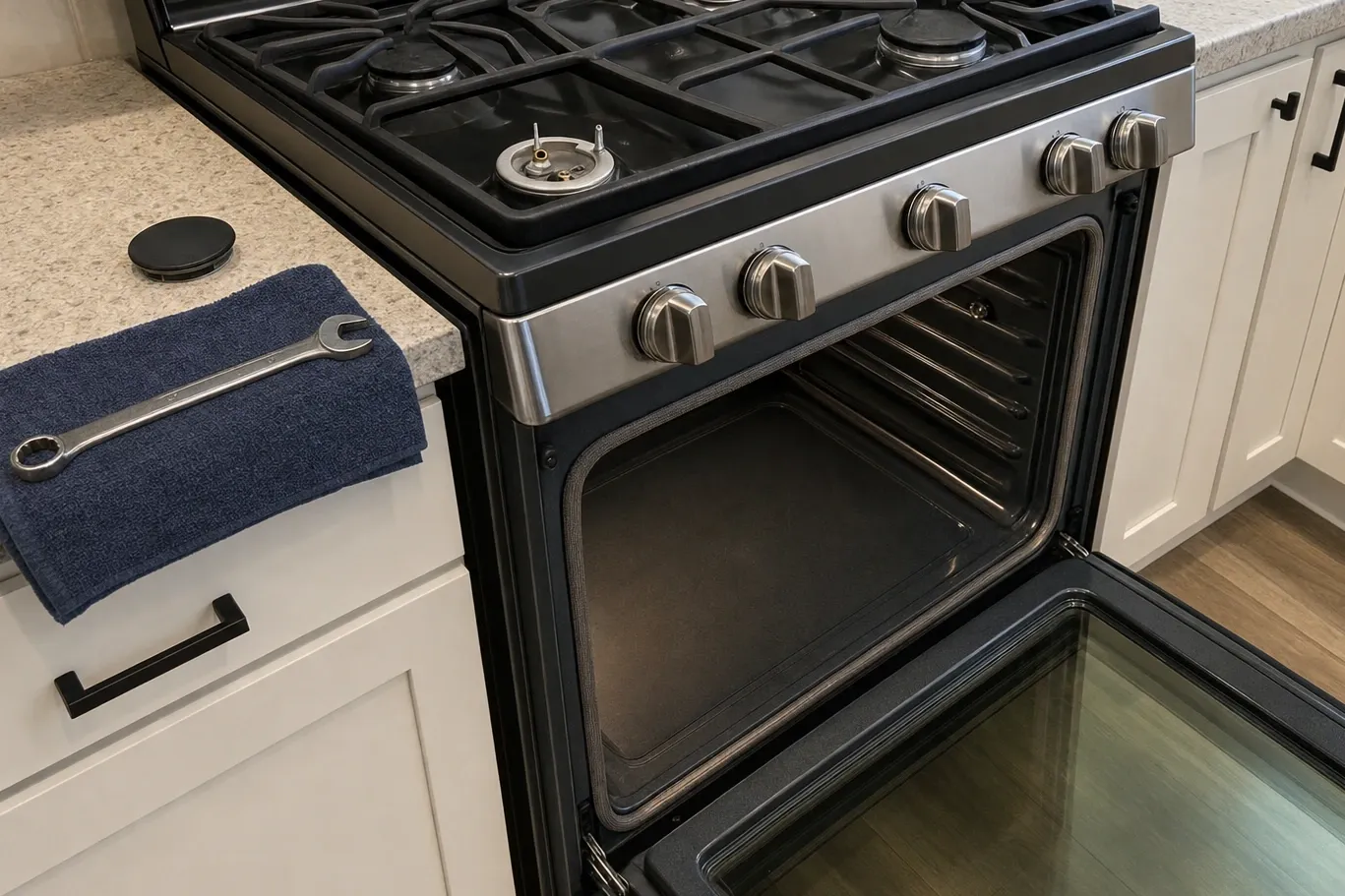
A stove top that gives no heat nearly always comes down to one of four things: no power reaching the spark system, a burner cap or set of ports blocked so gas cannot meet the spark, a worn or dirty igniter, or, on electric and induction tops, a failed element or control. Most owners can rule out the first two in about ten minutes without tools. In Phoenix it is worth starting with a clean: city water here is very hard, and a single pot of pasta water that boils over can leave a chalky white crust across the burner ports that stops a flame from spreading around the ring.
Start by identifying your cooktop
The checks depend on how your cooktop makes heat. Viking builds the 5 Series in widths from 30 to 60 inches, and the letters that open the model number tell you the type: VGR means gas with sealed burners, VGIC means gas with open burners, VDR pairs a gas top with an electric oven, VER is all-electric and VIR is induction. Gas and dual fuel tops light with a spark, electric tops heat a radiant element, and induction warms the pan itself through a magnetic field.
Your model number settles it. Viking hides the rating plate of a 5 Series gas range in one of three spots. Try the left side panel first, tucked under the support for the left front grate or the burner bowl; if it is not there, check the frame around the oven opening just under the knobs, and failing that, the underside of the controls directly over the door. Owners of a 7 Series will find their label by swinging the oven door down and looking up at the bottom edge of the control panel.
No clicking when you turn the knob
Viking’s own manual for the 5 Series gives a clear first step here: if turning a knob on produces no clicking, turn it back off, then confirm the range is plugged in and that its breaker or fuse has not tripped. A gas range still depends on household current for its spark, so a tripped circuit leaves every burner silent even though gas is available.
- Look at your electrical panel for a tripped breaker and reset it once.
- Try each burner in turn. If none of them click, the fault is shared, such as power or the spark module.
- If only one burner stays silent, the switch or wiring behind that one knob is the likely cause.
If power is confirmed and still nothing clicks, stop there. Diagnosing a spark module or knob switch means removing panels close to gas lines and live wiring, and that belongs with a technician.
Clicking, but no flame
This is the pattern most owners describe, and it is usually fixable at home. The igniter is sparking, so the problem is that gas is not reaching it in the right way.
- Check the cap. With the burner cool, lift the grate and the round cap. Set the cap back so it sits flat and centered on its base. Even a slight tilt leaves gaps the flame cannot cross.
- Clear the ports. Look at the small openings around the burner base. Grease, food or hard-water scale can plug them. Open each one with a straight pin or a stiff nylon brush; avoid toothpicks, which can snap off inside.
- Inspect the igniter. It is the small ceramic post with a metal tip beside the burner. A cracked post, or one coated in residue, gives a weak spark. Wipe it gently with a dry cloth.
- Let it dry. Water left on the igniter after cleaning will short the spark. Give it a few hours.
If you notice a gas smell while a burner clicks without lighting, turn the knob off and let the room air out before another try. Never hold a knob open for long stretches hoping it will catch.
One more case: every 5 Series gas range is built for a single fuel from the start, natural gas or LP. Converting one to LP calls for an optional kit, LPKPDR01, and the swap is gas work that Viking leaves to a qualified technician or installer rather than to homeowners. If burners began misbehaving right after a move or a fuel change, the setup may not match your gas supply, and that is not a do-it-yourself fix.
Clicking that will not stop
A 5 Series range relights a surface burner automatically if its flame goes out while gas is still flowing. That safety feature explains the noise: the range keeps sparking until it senses a flame. When it clicks on and on beside a perfectly good flame, it simply is not detecting that flame, usually because of moisture from a spill or a wipe-down, a cap that is not seated, or grime on the igniter tip.
Switch the burner off, dry the area thoroughly, overnight after a big spill, then reseat the cap and test again. If a clean, dry, correctly assembled burner keeps clicking, or the clicking starts with every knob off, a knob switch has probably taken on moisture or failed.
Lit, but weak or slow to heat
Sometimes a burner lights yet never gets a pan properly hot. Rule out the pan first, since a warped base or a small pan on a large burner wastes much of the heat. As a yardstick, each regular sealed burner on a 5 Series puts out 15,000 BTU when fed natural gas, dropping to 12,500 BTU when it runs on propane. Certain models also carry a TruPower Plus burner in the front right spot, good for 18,500 BTU with natural gas and 16,600 BTU with propane. Watch the flame. Uneven flames around the ring usually mean partly blocked ports, which you can clear as above. A tall yellow flame, or one that lifts away from the burner, points to an air or gas pressure issue that needs a professional.
On electric and induction tops, one zone that stays cold while others work suggests a failed element, a loose connection or a control fault. With induction, test with a pan that a magnet grips firmly before assuming anything is broken. On 7 Series ranges and rangetops with backlit knobs, a red backlight means an error code, with the griddle or oven knob rings flashing a set pattern. Note which ring flashes and how, because that detail speeds up the diagnosis.
When to call, and what it costs
Call for service if no burner clicks with power confirmed, a clean and dry burner still will not light, clicking never stops, a gas smell does not clear, or the flame burns yellow or lifts. Our range repair service covers homes in Moon Valley, Deer Valley, Paradise Valley Village and Laveen.
| Symptom it usually fixes | Likely repair | Typical range |
|---|---|---|
| Sparks but will not catch, or weak spark | Igniter or burner assembly | $170–$440 |
| Silent knobs, dead zones, error lights | Control board or touch panel | $440–$670 |
Treat those numbers as typical spans; we commit to a firm figure only after the fault has been diagnosed in your kitchen. Getting a technician to your door costs a flat $89, which includes working out exactly what failed; approve the repair and that charge is subtracted from its price. Call (480) 691-8120 or use the booking button on this page, and browse our other appliance guides for more checks you can make first.
Follow-up questions
-
Why is my Viking burner sparking without ever catching?
Clicking with no flame means the spark is working but gas and spark are not meeting. A crooked burner cap, ports plugged by a boil-over, or an igniter still damp from cleaning are the usual culprits. Turn the knob off, reseat the cap, dry everything and try again. If a clean, dry burner still refuses to catch, leave it off and book a visit.
-
Why won't my Viking burner stop clicking once it is lit?
Endless clicking with a healthy flame means the range cannot sense that flame, so it keeps sparking. Moisture around the igniter, a cap that is not sitting flat, or residue on the igniter tip are the common reasons. Let the burner dry for several hours and reassemble it carefully. If clicking continues, or starts with every knob turned off, a switch behind the knobs probably needs replacing.
-
What does a stove top burner repair usually cost?
Replacing an igniter or burner assembly typically falls between $170–$440, and a control board or touch panel typically runs $440–$670. Those are ranges, not quotes. Our visit is a flat $89 for the trip and a full diagnosis, that $89 is credited to the repair if you approve it, and you get a firm price once the fault is found.
-
Can I keep cooking on the other burners while one is broken?
Usually yes, as long as the faulty burner stays switched off and you smell no gas. Keep that knob in the off position and avoid leaning on it. If a gas smell appears and does not fade, turn every knob off, open the windows, skip light switches, leave the house and call your gas utility from outside.
rangeburnerigniternot-heating